
How to Teach Short Vowels, Long Vowels, Digraphs, Blends, Floss, Silent E, and R-Controlled Vowels the Right Way: The Science of Reading Phonics Roadmap:
- Anju

- May 18
- 8 min read
Teaching reading well starts with explicit, systematic phonics instruction that builds decoding skills step by step. Research shows that children need direct teaching of letter-sound relationships, dedicated practice, and decodable text that matches the patterns they have learned. Without this structure, early readers often rely on guessing, memorizing whole words, or using pictures as clues strategies that break down quickly as texts get harder.
This guide shows you how to teach the core phonics concepts students must master, and why each concept matters for accurate decoding, fluency, spelling, and comprehension.

Why These Phonics Concepts Are So Important
Phonics is not just a “nice-to-have.” It is the engine of skilled reading. When students understand how speech sounds map to letters, they can decode unfamiliar words, read more fluently, and spend less mental energy on word recognition. This frees up brainpower for comprehension.
Science of Reading research confirms that:
- Systematic phonics instruction*improves decoding and spelling for most early readers.
- Decodable text helps students apply newly taught patterns successfully.
- Explicit teaching of patterns like vowel sounds, blends, and digraphs prevents guessing habits from forming.
The concepts below are the non-negotiable building blocks of reading.
1. Short Vowels: The Foundation of CVC Decoding
Why Short Vowels Matter??
Short vowels (a, e, i, o, u) are the first major phonics pattern students must master. Almost every early reader begins with CVC (consonant–vowel–consonant) words like cat, bed, pin, hot, and sun. If a child cannot reliably identify short vowel sounds, they will struggle to decode even the simplest words.
Short vowel mastery also supports:
- Phonemic awareness (hearing and manipulating middle sounds).
- Blending (saying /c/ /a/ /t/ as cat).
- Spelling and dictation.
- Confidence with early readers.
How to Teach Short Vowels
1. Start with auditory discrimination
Say pairs of words and ask: “Do these have the same middle sound?”
- cat / hat?
- pet / pen?
- pit / pat?
2. Teach sound–letter connections explicitly
Show the letter, say the sound, and model how it appears in words.
3. Use Say–Tap–Map–Write
- Say the word.
- Tap each phoneme.
- Map letters into boxes.
- Write the word.
4. Practice word lists and word sorts
Sort words by vowel sound:
- a: cat, bat, mat
- e: pet, wet, net
- i: pin, win, sit
- o: hot, pot, dot
- u: sun, bun, run


5. Move to connected text
Use decodable stories with controlled short vowel words so students apply the skill in real reading, not just in isolation.


2. Long Vowels: Understanding Vowel Patterns and Silent E
Why Long Vowels Matter
Long vowels are the vowel’s “name” sound: /ā/, /ē/, /ī/, /ō/, /ū/. Many English words use long vowels, and children must learn that:
- A single vowel can make more than one sound.
- Specific patterns (like silent e or vowel teams) signal long vowel sounds.
- Long vowel knowledge is essential for decoding multisyllabic words later.
Without long vowel instruction, students will misread words like made, site, home, and cube as if they had short vowels.
How to Teach Long Vowels
1. Start with minimal pairs
Compare short vs. long:
- cap / cape
- pin / pine
- tad / tape
- hop /hope
- cub / cube
2. Teach the silent e pattern explicitly
Explain that silent e “makes the vowel say its name.”
Model how adding e changes the vowel sound and the word meaning.
3. Teach long vowel a, e, i, o, u separately
Each vowel has its own lesson sequence:
- Sound identification
- Word lists
- Word sorting
- Reading and writing practice
- Decodable text application
4. Use word sorts and sentence writing
Sort words by long vowel pattern, then write sentences using those words.
5. Reinforce with decodable stories
Choose texts that focus on one long vowel pattern at a time so students experience repeated, successful decoding.



3. Digraphs: Two Letters, One Sound
Why Digraphs Matter
Digraphs are letter pairs that make one sound: **sh, ch, th, wh**. These are not blends. Students must understand that two letters can represent a single phoneme. This is a major shift in how they think about spelling and decoding.
Without digraphs, students will:
- Try to sound out each letter separately.
- Misread words like ship, chip, think, and what.
- Feel frustrated by “impossible” words.
How to Teach Digraphs
1. Use sound-only instruction first
Isolate the sound: /sh/, /ch/, /th/, /wh/.
Have students repeat the sound and find words with that sound.
2. Teach each digraph explicitly
- Show the letters.
- Say the sound.
- Model words with the digraph.
3. Practice word lists and word sorts
Sort by digraph:
- sh: ship, fish, wish
- ch: chin, chop, rich
- th: this, thin, bath
- wh: whale, when, what
4. Move to connected text
Use decodable stories that focus on one digraph so students apply the skill in reading.
5. Include writing practice
Dictate words and sentences with the target digraph.


4. Floss Rule: When to Double f, l, s, z After a Short Vowel
Why the Floss Rule Matters
The floss rule explains why many short vowel words end with double letters: **ff, ll, ss, zz** (e.g., puff, hill, kiss, buzz). This pattern is highly predictable and foundational for spelling.
Without understanding the floss rule, students will:
- Misspell words like “puf” instead of “puff”.
- Be confused by why some words double and others don’t.
- Struggle with spelling generalizations.
How to Teach Floss
1. Explain the rule in student-friendly language
“After a short vowel, double f, l, or s at the end of one-syllable words.”
2. Model word families
- ff: puff, cliff, staff
- ll: hill, bell, call
- ss: kiss, pass, grass
- zz: buzz, fuzz, jazz
3. Use word sorts
Sort words into:
- Single f, l, s
- Double ff, ll, ss
4. Practice with dictation
Say words, have students write them, and check for correct doubling.
5. Use decodable stories
Provide texts with controlled floss words so students see the pattern in context.


5. Blends: S Blends, R Blends, and L Blends
Why Blends Matter
Blends are two or three consonants where each sound is heard (e.g., **st, sp, sl, fr, tr, cl, bl**). They are different from digraphs because each consonant keeps its sound.
Blends are essential because:
- They appear in hundreds of common early words.
- They are a major source of decoding errors if not taught explicitly.
- They help students build 3-sound and 4-sound words.
How to Teach Blends
Teach blends in three families:
S Blends (st, sp, sw, sk, sl, sm, sn, sr)
1. Model the sequence: /s/ + /t/ = st.
2. Practice word lists: star, stop, swan, skin, slip, smile, snap.
3. Sort words by blend.
4. Read and write decodable sentences.
5. Use decodable stories with controlled s-blend words.
R Blends (br, cr, dr, fr, gr, pr, tr)
1. Model each blend: /b/ + /r/ = br.
2. Practice word lists: brick, crab, drum, frog, green, print, train.
3. Sort and write.
4. Use decodable texts with repeated r-blend patterns.
L Blends (bl, cl, fl, gl, pl, sl)
1. Model each blend: /b/ + /l/ = bl.
2. Practice word lists: blue, clock, flag, glow, play, slip.
3. Sort and write.
4. Use decodable stories with controlled l-blend words.
For all blends: start with sounds, then words, then sentences, then connected text.





6. Silent E: The Classic Vowel-Changing Pattern
Why Silent E Matters
Silent e is one of the most common and powerful spelling patterns in English. It changes a short vowel into a long vowel and appears in thousands of words (made, site, home, cube, ride).
Without silent e instruction, students will:
- Misread and misspell hundreds of common words.
- Fail to understand why “mad” vs. “made” are different.
- Struggle with more complex vowel patterns later.
How to Teach Silent E
1. Use minimal pairs
mad / made, kit / kite, hop / hope, cub / cube.
2. Explain the pattern clearly
“Silent e is silent, but it makes the vowel say its name.”
3. Model word families
- a_e: cake, lake, name
- i_e: hike, vine, fine
- o_e: home, bone, rope
- u_e: cube, mule, tune
4. Practice word sorts
Sort short vowel vs. silent e words.
5. Use decodable stories
Choose texts that focus on one silent e pattern at a time.
7. R-Controlled Vowels: The “Bossy R” Patterns
Why R-Controlled Vowels Matter
R-controlled vowels (ar, er, ir, or, ur) change the expected short or long vowel sound. The r “bosses” the vowel, and the vowel no longer sounds like its usual short or long sound.
Examples:
- ar: car, star, park → /ar/
- er: her, term, under → /er/
- ir: bird, first, girl → /er/
- or: horn, fork, corn → /or/
- ur: burn, nurse, turn → /er/
Without explicit instruction, students will try to read these as normal short or long vowels and fail.
How to Teach R-Controlled Vowels
1. Teach each pattern separately
Start with /ar/, then /er/, /ir/, /or/, /ur/.
2. Use sound-only practice first
Say the pattern: /ar/, /er/, /or/.
3. Model word lists and word sorts
Sort by pattern:
- ar: car, star, farm
- er: her, Peter, under
- ir: bird, first, girl
- or: horn, fork, corn
- ur: burn, nurse, turn
4. Use word mapping
Tap, map, and write words with r-controlled vowels.
5. Use decodable stories
Choose texts that focus on one r-controlled pattern per story so students experience repeated success.
How to Use This Instructional Sequence
A strong phonics sequence looks like this:
1. Teach the concept explicitly
Name the pattern, show the letters, say the sound.
2. Practice with word lists and word sorts
Build recognition and discrimination.
3. Use Say–Tap–Map–Write phoneme mapping
Strengthen sound–letter connections and spelling.
4. Move to sentences and dictation
Apply the skill in writing.
5. Read decodable text with the target pattern
Reinforce accuracy, fluency, and comprehension.
6. Review and recycle patterns
Revisit earlier patterns in new contexts to build automaticity.
This is the exact structure that science of reading research supports.
What Students Practice in Structured Phonics Workbooks
In a well-designed workbook, students practice these skills through:
- Targeted word lists (e.g., AR word lists for r-controlled vowels).
- Say–Tap–Map–Write phoneme mapping.
- Poster-style phonics word charts.
- Word sorting by vowel pattern.
- Read and write phonics practice.
- Find and circle targeted phonics words.
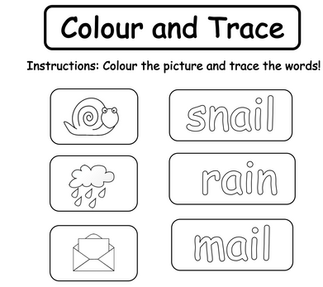
- Trace and colour targeted phonics words.
- Word search activities.
- Scrambled word decoding.
- Picture-to-sentence matching.
- Sentence writing using target words.
- Decodable passages with fill-in-the-blank practice.
- Read, write, and draw activities.
These activities build decoding, encoding, spelling, fluency, and sentence-level writing.
What Students Practice in Decodable Readers
Decodable readers are built to support exactly this kind of instruction. A strong decodable:
- Focuses on one targeted pattern per text.
- Uses carefully controlled vocabulary based on previously taught skills.
- Provides repeated exposure to the target pattern.
- Includes short-answer comprehension questions.
- Includes multiple-choice comprehension questions.
- Connects sentence writing to the story.
- Includes Write–Copy–Cover fluency practice.
- Offers extension activities for deeper learning.
- Includes draw-and-respond tasks.
- Embeds story-based spelling reinforcement.
This design helps students move from isolated practice to real reading success.
A Complete, Research-Aligned Phonics Series for Teachers and Parents
If you want a structured, systematic resource that follows this exact instructional sequence, The Science of Reading Phonics Workbook and Decodable Series offers a complete 24-book collection that covers all the core concepts explained above:


Individual Links:
Short vowel workbook: https://a.co/d/040yRZ7z
Short vowel decodable: https://a.co/d/04ORaynT
Floss decodable : https://a.co/d/04rCnjCQ
Floss workbook: https://a.co/d/05rB2doY
Digraph workbook https://a.co/d/00089G78
Digraph decodable https://a.co/d/0hEq1WbJ
S blend workbook : https://a.co/d/06hQKNW2
S blend decodable https://a.co/d/0g9EF4NB
R blend workbook: https://a.co/d/0g4Tv6Y7
R blend decodable- https://a.co/d/0dkF8xTX
L blend workbook : https://a.co/d/0eLXtwAf
L blend decodable: https://a.co/d/08Ow3DqV
Silent e workbook: https://a.co/d/06X72w73
Silent e decodable: https://a.co/d/0eoLT5Ef
R controlled vowel /ar/. https://a.co/d/08LSIPDU
R Conroe elf vowel ‘er/ https://a.co/d/0bYzvvL4
R controlled vowel /or/. https://a.co/d/0ff4NQVG
R controlled decodable : https://a.co/d/0diSUD5F
Long vowel a: https://a.co/d/03vB4RxO
Long vowel e: https://a.co/d/01T0pdYg
Long vowel i : https://a.co/d/0gerEaqd
Long vowel o : https://a.co/d/05H8pT08
Long vowel u : https://a.co/d/08wmSbS9
Long vowel decodable : https://a.co/d/0bWeV5lv
Use this series as your go-to resource for explicit phonics structured practice, and decodable reading that aligns with how children actually learn to read.
Love
Anju


Comments